North Western Province
Yapahuwa
Rising abruptly from the plains of Sri Lanka's North Western Province, Yapahuwa is one of the island's most dramatic yet overlooked ancient sites. Briefly the capital of Sri Lanka in the thirteenth century, this rock fortress combines military ingenuity with religious artistry in a setting that rivals the more famous Sigiriya. For British travellers willing to venture beyond the well-trodden Cultural Triangle, Yapahuwa offers a rewarding encounter with history, architecture, and panoramic views without the crowds.
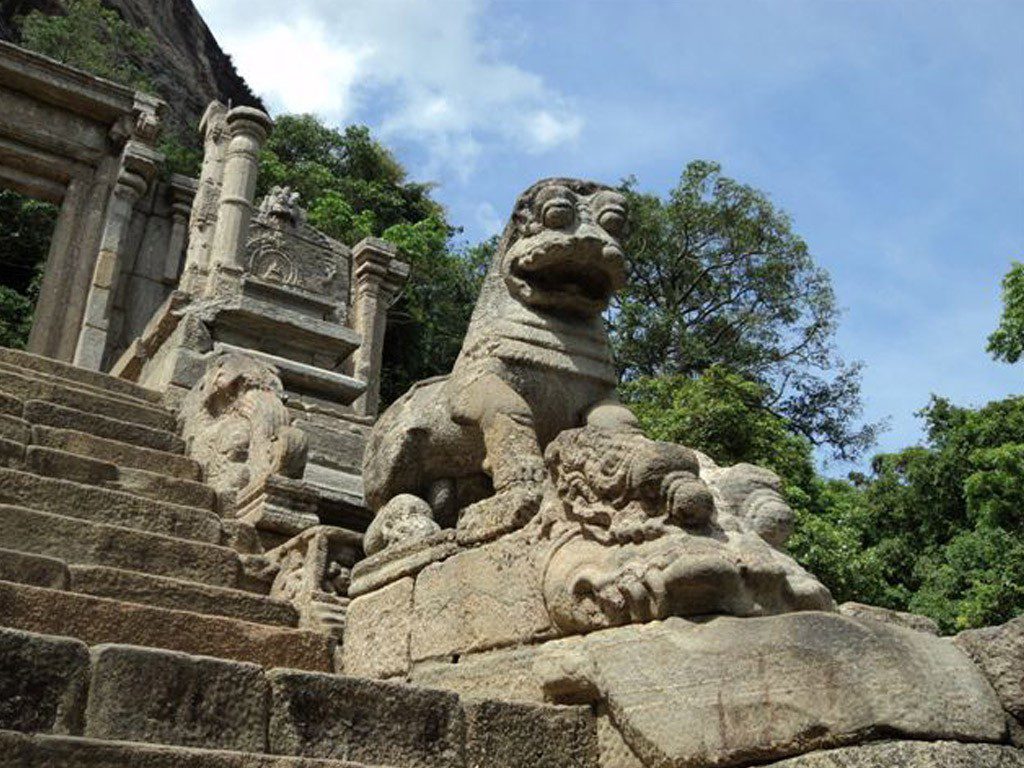
The approach to Yapahuwa is striking. A long, steep staircase flanked by elaborate balustrades leads upward to the former royal palace and temple complex perched on the rock summit. The stone lions that once guarded the entrance — reminiscent of those at Sigiriya — testify to the symbolic power invested in this remote stronghold. Although the palace itself lies in ruins, the sense of elevation and strategic command over the surrounding countryside is immediately apparent.
The site's most celebrated treasure is the ornate stone doorway that once led to the Temple of the Tooth, when the sacred relic was kept here for safekeeping during a period of political instability. Now preserved in the National Museum in Colombo, the doorway's intricate carvings — including figures of Brahmin priests and dancers — remain on site as a testament to the craftsmanship of the period. The Yapahuwa period represents a fascinating, transitional chapter in Sri Lankan history, bridging the great Sinhalese kingdoms and the eventual shift of power southward.
Exploration of Yapahuwa is straightforward. A climb of roughly twenty minutes brings you to the summit, where views extend across coconut plantations and distant hills. The lower terraces contain remains of monastic buildings and defensive walls, while the upper levels hold the foundations of the royal residence and shrine rooms. Informative signage helps visitors orient themselves, though a local guide can enrich the experience with historical context.
Yapahuwa receives far fewer visitors than Anuradhapura or Polonnaruwa, which is part of its appeal. The site feels undiscovered, allowing time for unhurried photography and quiet contemplation. It pairs well with a journey through the North Western Province, perhaps combined with visits to Kurunegala or the rock temple at Dambadeniya, another short-lived capital nearby.
The climb requires moderate fitness and sensible footwear — the steps are steep in sections, though rest stops along the way offer shade and views. There is little infrastructure at the summit, so carry water and sun protection. A knowledgeable guide from nearby Maho or Kurunegala can explain the site's brief but dramatic history, including the theft of the Tooth Relic by invading forces. Allow two hours for the visit, including the ascent, exploration, and descent.
Yapahuwa is reached by road from Kurunegala in approximately forty minutes, or as a detour when travelling between the Cultural Triangle and the west coast. The dry season from December to April offers the clearest views from the summit, though the rock is accessible year-round. For photographers, late afternoon light casts long shadows across the plains and illuminates the carved doorway with warmth that enhances every detail. Few sites in Sri Lanka combine dramatic ascent, royal history, and solitude quite so satisfyingly.
For British travellers with a taste for archaeology and off-the-beaten-path discovery, Yapahuwa is a gem. It rewards those who seek the lesser-known chapters of Sri Lanka's past — a fortress city that held the nation's most sacred relic and left behind ruins as evocative as they are enigmatic. To climb its steps is to follow in the footsteps of kings, monks, and pilgrims who once made this rock their refuge and their throne.